
Everybody wants cheap wedding flowers and nobody wants flowers that look cheap. Those are different problems with the same solution: stop reducing quality across the board and start reducing scope deliberately.
A florist can build you a wedding at almost any budget. What changes is not the standard of the work but how much of the venue gets touched. Understanding where cost actually sits lets you cut 40% and lose almost nothing visible.
Where the Money Actually Goes
Three things drive floral cost, and only one of them is the flowers.
Stem count. Linear and unavoidable. More flowers cost more.
Labour. Often the larger share. A hundred individually wired buttonholes is a full day’s work. A single large arrangement using the same stem count is an hour.
Mechanics and logistics. Vessels, foam, wire, frames, stands, delivery, install, and pack-down. Suspended and structural work adds rigging.
Cheap wedding flowers come from attacking labour and mechanics, not from asking for worse flowers.
The Cuts That Do Not Show
Cut the number of arrangements, not the size of them. Six generous centrepieces on alternating tables looks abundant. Twelve thin ones looks stretched. Guests do not audit table coverage.
Cut aisle flowers. They are visible for twenty minutes, appear in almost no photographs, and are among the first things a florist would remove. Use potted plants or nothing.
Cut bathroom, gift-table and sign flowers. Nobody photographs these. They are pure margin against your budget.
Cut cake flowers and ask for a few loose stems the baker or a family member can place. A florist charges for the design time; three stems laid on a cake takes thirty seconds.
Cut buttonholes to the essential people. Groom, best man, two fathers. Every additional one is labour, not flowers.
Cut suspended and structural installations. These carry rigging, engineering and venue approval costs on top of stems.
Cut all-white. White is one of the most expensive briefs in floristry because it needs volume to read as luxurious rather than sparse. A single-variety colour at the same budget looks considerably richer.
What Never to Cut
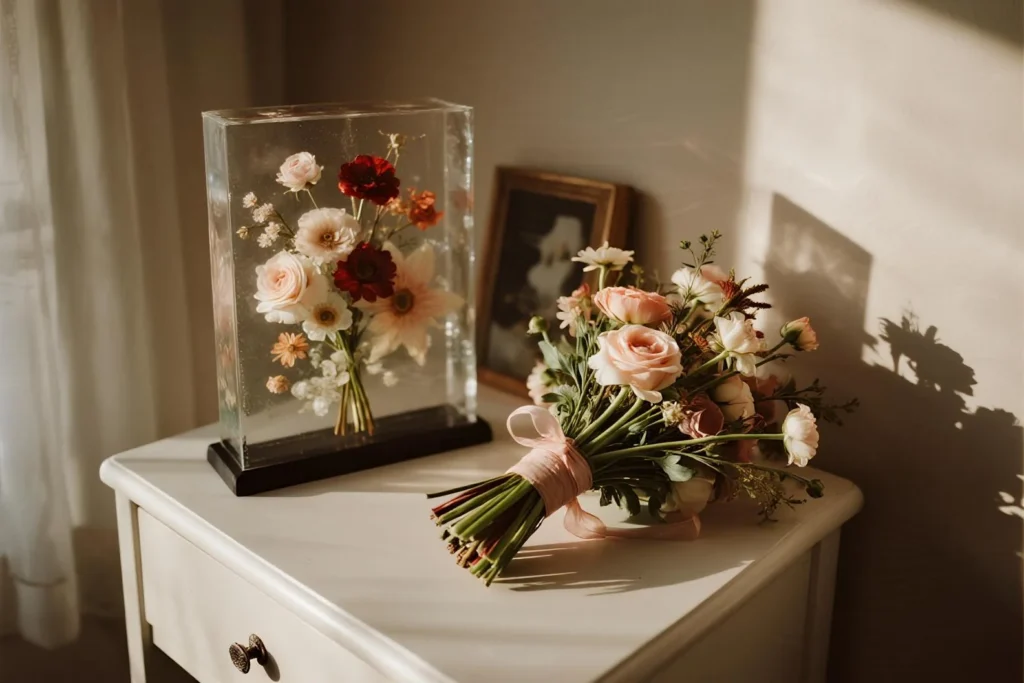
The bridal bouquet. It appears in every photograph, is held at chest height all day, and is the one floral item people remember. Spend here even if you cut everywhere else.
One hero moment. A single arrangement guests walk into – an entry piece, a ceremony backdrop, a top-table run. Concentration reads as abundance. Even distribution reads as thin.
Delivery and install. DIY sounds like a saving and is usually a false economy. Somebody has to collect, transport, condition and place flowers on the morning of the wedding, in Sydney traffic, in whatever the weather is doing. That person is a member of your wedding party who then has no time to get ready.
Seasonal Substitution: The Biggest Single Saving
This is where the real money is, and it costs nothing aesthetically.
Out-of-season and imported specifics are the most expensive line on any wedding quote. Peonies in March. Ranunculus in January. Specific rose varieties in a colour that is not currently coming out of the growers. All possible, all air-freighted, all several times the price of a superb in-season alternative.
Spring (Sep-Nov): ranunculus, tulip, sweet pea, stock, freesia, garden rose, blossom branch. Peony in October and November only. Best volume for money in the year.
Summer (Dec-Feb): hydrangea, dahlia, lisianthus, agapanthus, orchid. Design for heat.
Autumn (Mar-May): chrysanthemum in bronze and antique tones, dahlia, protea, banksia, celosia, berried foliage. The cheapest genuinely beautiful season in Sydney, and the longest-lasting.
Winter (Jun-Aug): anemone, hellebore, magnolia branch, camellia, wattle, waratah. Also the cheapest time to book a florist at all, because demand is low.
The most useful sentence you can say at a consultation: “What is superb and inexpensive in my month?” Then build the palette around the answer rather than fighting it.
Foliage and Branches: The Volume Trick
Form and scale cost far less than flowers.
- Foliage-led installations with flowers only at eye level. Gum, olive, ruscus and camellia foliage build enormous volume cheaply.
- One branch instead of thirty stems. A single magnolia or blossom branch delivers the scale of a large arrangement for a fraction of the cost.
- Long-and-low table runners built on a foliage base with flowers distributed through it. Reads generous, uses relatively few blooms.
- Australian natives are locally grown, robust, and often better value than imported focal flowers. Banksia, protea, waratah, kangaroo paw and gum foliage handle heat and last for days.
NSW has a substantial local cut flower and native flower industry, concentrated around the Sydney basin and along the coastal strip, described in the state’s horticulture and primary industries information. Buying from that supply chain rather than from imported lines is both cheaper and produces flowers that hold up better on a long day.
Reuse: Worth 20-30% of a Budget
The most reliable saving available, and it needs to be planned rather than improvised.
- Ceremony arbour becomes the reception backdrop or splits into two entry arrangements. Design it in movable sections.
- Aisle arrangements become table centrepieces – but only if they are in vessels rather than spiked into ground.
- Bridesmaid bouquets become the top table, lined up in small vases. Ask for the vessels to be on site.
- Ceremony pedestals move to the bar.
Agree this at the consultation, because it changes the mechanics, and nominate a specific person to physically move things during the transition. “Someone will do it” means nobody does.
Realistic Sydney Numbers
Rough guidance for 2026, buying direct from a workroom:
- $800-1,500 – bridal bouquet, two or three bridesmaid bouquets, buttonholes, and one modest ceremony arrangement. Achievable, and honest.
- $1,500-3,000 – the above plus proper ceremony flowers and centrepieces on most tables.
- $3,000-6,000 – a fully dressed wedding with a hero installation.
- $6,000+ – large-scale statement work, structural installations, or high stem counts across a big guest list.
A competent florist will tell you honestly what a number can and cannot cover. Be direct about your figure at the first meeting rather than trying to negotiate down from a quote – it lets them design to the budget instead of stripping a design that was never affordable.
DIY: When It Works and When It Does Not
Works: bud vases, potted plants as aisle markers or favours, loose stems on a cake, a garland made a day ahead from foliage, dried arrangements built weeks in advance.
Does not work: the bridal bouquet, anything installed on the day, anything requiring conditioning, and anything in Sydney summer heat. Bouquet construction is a genuine skill, wholesale market access is restricted to licensed buyers, and a bouquet built without conditioning wilts by the reception.
The skills involved are trade skills, taught formally, and it shows. Australian research on postharvest handling and vase life documents how sharply conditioning and treatment affect how long stems hold – which is the difference between flowers that survive to the reception and flowers that do not.
Also Check the Venue Rules Before You Design
Council parks and reserves set conditions on pegs, adhesives, freestanding structures, open flame and what must be removed afterwards. Finding out late can force an expensive redesign. The relevant park and reserve hire conditions list hire terms and structural limits for local reserves.
Seven Questions That Save Money
- What is superb and inexpensive in my month?
- What would you cut first if we needed to drop 30%?
- What can be reused between ceremony and reception?
- Where is my budget currently being wasted?
- Can we use foliage and branches for scale instead of blooms?
- What natives would work in this palette?
- What does the venue actually allow?
The Bottom Line
Cheap wedding flowers are not cheaper flowers – they are fewer, larger, in-season arrangements concentrated where people look, built on foliage and branches, and reused between ceremony and reception. Protect the bridal bouquet and one hero moment, cut the aisle, bathroom and cake flowers without hesitation, and ask what is excellent in your month rather than what you saw on Pinterest in someone else’s hemisphere.