
Most wedding flowers ideas circulating online were photographed in a controlled studio in the northern hemisphere in October. Sydney weddings happen in harbour wind, western sun, 34-degree February afternoons and venues with two-hour bump-in windows.
This is a list of ideas that work in those conditions, ordered roughly by how much difference they make. Some are aesthetic. Most are structural, because structure is what determines whether the aesthetic survives to the photographs.
Start With the Venue, Not Pinterest
The single most useful idea in Wedding Flowers Ideas is to design for the room you are actually in.
High ceilings need height. A beautiful low centrepiece in a room with a five-metre ceiling disappears. Branches, tall footed vessels and elevated arrangements read; posies do not.
Bushland and garden ceremonies need warm, light palettes. Deep reds, burgundies, blues and purples vanish against dense green foliage – which describes most Sydney reserves, from Lane Cove River to the Hunters Hill peninsula. Coral, peach, cream, gold and rust read from twenty metres. Sage and burgundy against a bushland backdrop photographs as a dark smudge.
Harbour and waterfront venues are windy. Loose garden-style arrangements shred. Tighter designs, weighted vessels and pinned installations survive. Anything on a stand needs to be genuinely heavy or physically secured.
Sandstone and heritage interiors already have enormous texture. They suit fewer, larger arrangements rather than many small ones.
Marquees and blank spaces need the flowers to do all the work, which means a bigger budget for the same visual effect. Factor that in early.
The Reallocation Idea That Saves the Most Money
Most couples spread the floral budget evenly and end up with everything slightly underdone. The better approach is deliberate concentration.
Spend heavily on: the bridal bouquet (it is in every photograph and held at chest height all day), and one hero installation that guests walk into.
Spend moderately on: the top table or a few statement centrepieces.
Spend lightly on: aisle markers, bathroom flowers, cake flowers, and the tables furthest from the camera.
This produces photographs that look like a much larger budget, because photographs concentrate on exactly the things you concentrated on.
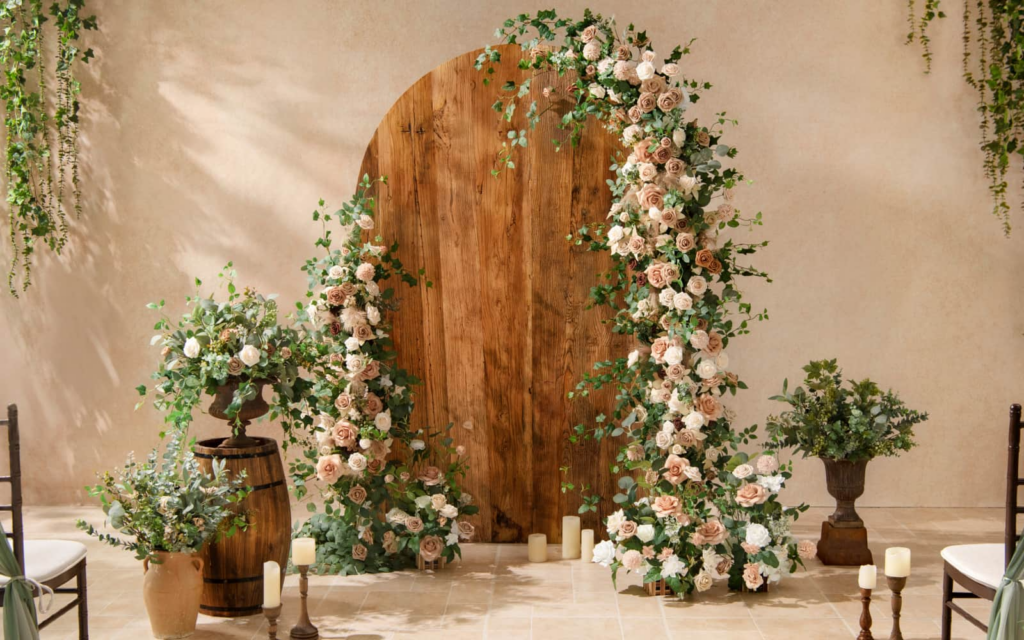
Reuse, Properly Planned
The most underused idea in Sydney weddings. Almost everything can work twice if it is designed to.
- Ceremony arbour becomes the reception backdrop or is split into two entry arrangements. Design it in movable sections from the start.
- Aisle arrangements become table centrepieces. They need to be in vessels, not spiked into the ground.
- Bridesmaid bouquets become top-table flowers in a row of small vases. Ask for vessels to be on site.
- Ceremony pedestals move to the bar or the entry.
This needs to be agreed in advance because it changes the mechanics and requires someone nominated to physically move things during the transition. It is worth 20-30% of a floral budget.
Heat-Proofing: Non-Negotiable for Sydney Summer
December to March in Sydney is genuinely hostile to flowers.
Choose heat-tolerant stems. Lisianthus, chrysanthemum in modern antique tones, orchid, carnation, alstroemeria, and all natives handle heat well. Hydrangea, gardenia, sweet pea, magnolia and peony do not – hydrangea in particular will collapse within an hour out of water.
Build in water where possible. Vessel arrangements survive; hand-tied bouquets out of water do not. Ask for the bridal bouquet to be delivered in water and only taken out at the last moment.
Keep everything in shade until the ceremony. A bouquet on a sunlit windowsill during hair and makeup is a bouquet that has already peaked.
Natives are the honest answer for a hot outdoor Sydney wedding. Banksia, protea, waratah, kangaroo paw, gum foliage and waxflower were built for this climate. They also look distinctly Australian rather than like a European wedding transplanted.
Seasonal Ideas for Sydney
Spring (Sep-Nov) – the best season, and the busiest. Ranunculus, tulip, sweet pea, stock, freesia, garden rose, blossom branch. Peony has a genuine window in October and November; if you want it, book early and accept the price. Blossom branches are the cheapest way to get real scale.
Summer (Dec-Feb) – hydrangea, dahlia, lisianthus, agapanthus, orchid, gardenia. Design for heat first and aesthetics second. Ask specifically about morning delivery and shaded holding.
Autumn (Mar-May) – the best-value season and, in many florists’ view, the most beautiful. Chrysanthemum in bronze and antique tones, dahlia, protea, banksia, celosia, berried and rust-toned foliage. Warm, rich, longlasting.
Winter (Jun-Aug) – anemone, hellebore, magnolia branch, camellia, wattle, waratah. Flowering branches are extraordinary in high-ceilinged interiors and cost far less than an equivalent volume of blooms. Winter is also the cheapest and least contested time to book a florist.
Ideas That Reliably Punch Above Their Cost
- Branches instead of blooms for scale. One magnolia or blossom branch does the work of thirty stems.
- Foliage-heavy installations with fresh flowers only at eye level.
- A single variety in volume. Fifty white tulips on a top table beats a mixed arrangement at the same price.
- Candles carrying the tables, with small floral accents. Check your venue allows open flame – many do not.
- Potted plants and natives as aisle markers, given away as favours afterwards.
- Long-and-low table runners using foliage as the base and fewer flowers spread through it.
- Bud vases in clusters. Cheap, charming, easy to reuse, and forgiving if one gets knocked over.
Ideas That Cost More Than People Expect
- All-white palettes. White needs volume to read as luxurious rather than sparse. It is one of the most expensive briefs in floristry.
- Full flower walls and ceiling installations. Enormous stem counts and significant labour and rigging.
- Out-of-season specifics. Peonies in March. Ranunculus in January. Possible, imported, expensive.
- Hundreds of individual buttonholes. Labour-intensive per unit.
- Suspended installations. Rigging, engineering and venue approval on top of flowers.
Venue and Council Conditions Change Designs
Check this before you commit to a concept, not after.
Many Sydney ceremonies happen in council parks and reserves, and each has conditions on what may be installed. Pegs, adhesives, freestanding structures, open flame, confetti and what must be removed afterwards are all commonly regulated. If your ceremony is in a reserve, the relevant park and venue hire conditions set out hire terms, access windows and structural limits, and they will reshape a floral plan faster than any mood board.
Worth also confirming the legal side is sorted alongside the flowers – the NSW Government’s guidance on getting married in NSW covers celebrant requirements and the one-month Notice of Intended Marriage period, which is easy to overlook while you are choosing colour palettes.
The Native Idea, Argued Properly
Australian natives are the most underused wedding flowers idea in Sydney, and the arguments for them are practical rather than patriotic.
They handle heat. They last for days rather than hours. They are grown locally rather than air-freighted, so they arrive with more of their life intact. And they photograph as distinctly Australian.
The horticulture supports this. NSW’s cut flower industry includes a substantial native and wildflower sector, documented in the state’s horticulture and primary industries resources, with growers along the coastal strip and inland. Australian research on postharvest handling of native cut flower genera shows how these species behave differently to imported lines, which is exactly why they survive a long outdoor day.
Questions to Ask at the Consultation
- What has worked and not worked at this specific venue?
- What is the bump-in window and what does that rule out?
- Which of my choices will struggle in the forecast conditions?
- What can be reused between ceremony and reception, and who moves it?
- What would you cut first if we needed to save 20%?
- What is in season and excellent in my month?
- Are we allowed pegs, open flame, confetti and freestanding structures here?
The Bottom Line
The best wedding flowers ideas are venue-led, season-led and weather-aware. Design for the room and the forecast, concentrate the budget on the bouquet and one hero moment, plan reuse from the start, and lean on natives and branches for scale. Do that and the flowers will look better in the photographs than a much larger budget spread evenly across everything.